
Disclosure: This article contains affiliate links. If you purchase through them, Thrive Trilogy earns a commission at no extra cost to you. This never influences our analysis — all reviews are based solely on the science. Learn more about our affiliate relationships.
The NMN Bioavailability Crisis: Why 90% of Supplements Are Dead on Arrival — And the Chemistry Behind the 10% That Aren’t
🧪 Editor’s Update (March 2026): When this article was first published, the focus was heavily on liposomal delivery as the theoretical gold standard. After deeper review of recent human pharmacokinetic data, that position has been refined. High-quality standard capsules remain a cost-effective starting point for most people. Before spending premium money on liposomal NMN, read the updated breakdown: Liposomal NMN vs. Capsules.
The Uncomfortable Truth About What You’re Actually Swallowing
Before spending another dollar on NMN, there is one fact that deserves to sit at the front of every purchase decision: most NMN products on the market are not delivering what their labels claim. Not because of fraud — but because of chemistry.
Nicotinamide mononucleotide (C₁₁H₁₅N₂O₈P) is a nucleotide — a molecule built from a nicotinamide base, a ribose sugar, and a phosphate group. It is also chemically fragile in a way the supplement industry is banking on most consumers never learning.
When raw NMN powder encounters the aqueous, acidic environment of the stomach, it undergoes hydrolysis. The phosphate bond cleaves. The ribose separates. What remains, in large part, is plain nicotinamide: Vitamin B3. The consumer paid $80–$120 for a biochemical process that converts a sophisticated NAD⁺ precursor into a vitamin available for under $6. The molecule never reached the cells intact.
This is not a fringe concern — it is basic biochemical kinetics, and the supplement industry has done a thorough job of burying it under marketing copy about “cellular energy” and “longevity pathways.”
Understanding where NMN fails in transit, and what a formulation that actually survives looks like, is the only way to evaluate whether any given product is worth the investment.
Why NMN Matters: The NAD⁺ Pathway
To understand why delivery is everything, the pathway NMN is supposed to travel needs to be clear.
NMN → NAD⁺ → Sirtuin Activation
The enzyme nicotinamide mononucleotide adenylyltransferase (NMNAT) converts intact NMN into NAD⁺ by coupling it with ATP. NAD⁺ then serves as the essential cofactor for sirtuins — the protein class most directly linked to metabolic regulation, DNA repair, and cellular aging phenotypes. AMPK is a separate but complementary energy-sensing pathway that converges on many of the same downstream targets, including mitochondrial biogenesis via PGC-1α. This is why the NMN/NAD⁺ axis pairs naturally with AMPK-activating compounds — but that’s a subject for the dihydroberberine deep-dive.
The point is: the pathway only delivers value if intact NMN reaches NMNAT inside target cells. Everything that happens between swallowing a capsule and intracellular delivery is an attrition problem.
NMN provides the fuel. Compounds like Resveratrol provide the sirtuin activation signal. But neither works if the fuel never arrives.
The Three-Layer Absorption Problem
Layer 1: Gastric Hydrolysis
Stomach pH sits between 1.5 and 3.5. At this acidity, NMN’s phosphoanhydride bond is thermodynamically unstable. Hydrolysis — the acid-catalyzed cleavage of that bond — occurs rapidly in this environment, converting NMN to nicotinamide and ribose before the compound even reaches the small intestine. Standard cellulose capsules offer no protection against this process; they dissolve within minutes of gastric contact and expose the raw powder to the full acidic environment.
Layer 2: CD73 Dephosphorylation
Research indicates that even NMN which survives gastric transit faces a second conversion step at the intestinal epithelium. The enzyme CD73, expressed on intestinal cell surfaces, dephosphorylates NMN into nicotinamide riboside (NR) prior to cellular uptake. The cell then re-phosphorylates NR back to NMN internally. This conversion adds metabolic attrition at the point of entry — NMN that was supposed to enter cells directly is instead taking a detour through a less efficient conversion step.
Layer 3: Gut Microbial Deamidation
Studies in Science Advances have demonstrated that a significant fraction of orally administered NMN is deamidated by gut microbiota before systemic absorption. The product of this deamidation is nicotinic acid (NA), which enters NAD⁺ synthesis via the Preiss-Handler pathway — a less direct and less efficient route than the salvage pathway that intact NMN is intended to use. The microbiome, in effect, intercepts a portion of every oral dose and redirects it into a lower-yield biosynthetic channel.
The combined result: Standard raw NMN powder in a plain capsule faces sequential molecular attrition at the gastric, intestinal, and microbial level. The actual NAD⁺ uplift in target tissues is a fraction of what the dose label implies — and that fraction varies substantially between individuals based on gastric acid output, CD73 expression levels, and microbiome composition.
This is why NMN bioavailability is the central variable in any serious evaluation of NAD⁺ precursor supplementation, and why formulation type is not a secondary consideration.
What a Stable Formulation Actually Looks Like
A formulation that survives the three-layer attrition problem described above must solve one core engineering challenge: protect intact NMN through the gastric environment and deliver it to the small intestinal epithelium structurally undamaged.
Liposomal Encapsulation
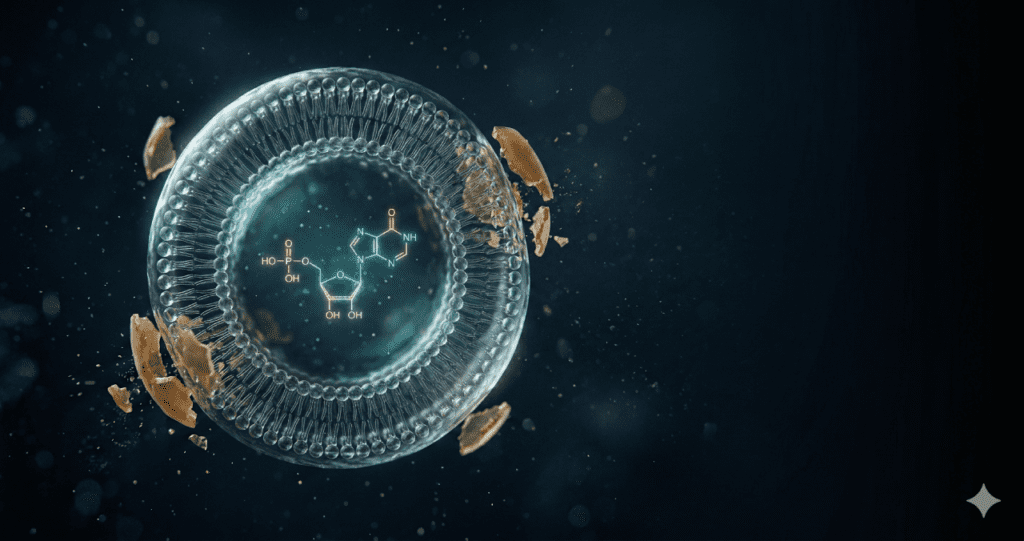
Liposomal delivery is the most chemically validated approach currently available for NMN. The mechanism is straightforward: NMN is enclosed within phospholipid bilayer vesicles — structures that mirror the architecture of cell membranes. This lipid shell is chemically inert to gastric acid. Digestive enzymes cannot cleave it effectively. The liposome physically shields the NMN cargo from hydrolytic degradation until it reaches the small intestine.
At the intestinal epithelium, two uptake routes become available:
Direct membrane fusion: The phospholipid bilayer of the liposome merges with intestinal cell membranes, depositing NMN directly into the cytoplasm and bypassing transporter-mediated absorption entirely.
Endocytosis: Nano-sized vesicles (typically 100–200nm) are internalized whole by intestinal cells, releasing NMN intracellularly after vesicle breakdown.
Both mechanisms achieve substantially higher intracellular NMN concentrations than standard powder formulations, with plasma NMN levels sustained over a longer window — avoiding the rapid spike-and-clearance profile of unprotected raw powder.
One important note from the updated evidence base: high-quality standard capsules — particularly those manufactured under tight GMP conditions with confirmed purity — still deliver meaningful NAD⁺ uplift in human trials. Liposomal is the ceiling; well-made capsules are not worthless. What is worthless is cheap raw powder with no manufacturing quality controls, no third-party testing, and no attention to stability. That is the product responsible for most of the NMN bioavailability failures in the field.
What to Verify Before Purchasing
Formulation type is the primary lever, but several verification criteria determine whether a specific product actually delivers what the formulation claims.
Third-party Certificate of Analysis (CoA): Publicly accessible on the product page — not “available on request.” CoA should confirm both potency (actual NMN content per capsule) and purity (absence of heavy metals, microbial contamination, and degradation byproducts).
GMP-certified, FDA-registered manufacturing: Non-negotiable for any formulation where the active compound is chemically unstable. GMP certification means the facility operates under quality control protocols that cover raw material testing, in-process controls, and finished product verification.
Phospholipid source transparency (for liposomal): Sunflower lecithin (non-GMO) is preferred over soy-derived for allergen profile and oxidative stability. Products that do not disclose their phospholipid source are not meeting the transparency standard that a premium liposomal formulation should clear.
Confirmed vesicle size (for liposomal): True liposomal formulations specify vesicle diameter. Sub-200nm is the threshold for efficient endocytic uptake. Products claiming “liposomal” without documented particle size data are likely using low-quality emulsification that produces particles too large for meaningful endocytosis.
The Formulation That Meets This Standard: NMNBio
NMNBio (affiliate link) produces pharmaceutical-grade NMN with documented batch testing and manufacturing transparency — the NAD⁺ precursor formulation consistent with the bioavailability standards discussed in this article.
→ Verify NAD+ Clinical Batch (affiliate link)
For Liposomal NMN: Renue by Science
Renue by Science (affiliate link) offers a liposomal NMN formulation with third-party testing infrastructure and disclosed manufacturing standards — consistent with the formulation criteria above.
→ Verify Liposomal NMN Formulation & Pricing (affiliate link)
The Chemist’s Protocol: How to Take NMN Correctly
Delivery form determines the ceiling. Administration protocol determines whether you reach it. The two variables are independent — a well-formulated liposomal NMN taken at the wrong time, with the wrong co-factors, still underperforms its potential.
|
Time |
Compound |
Dose |
Why |
|---|---|---|---|
|
Morning, fasted |
NMN (liposomal or high-quality capsule) |
500mg |
NAD⁺ biosynthesis follows a circadian rhythm; NAMPT — the rate-limiting enzyme in the salvage pathway — peaks in the early active phase. Fasted administration aligns substrate availability with peak enzymatic activity |
|
Immediately after NMN |
Trans-Resveratrol (micronized) |
500mg |
Resveratrol is an allosteric SIRT1 activator — it increases the catalytic efficiency of the enzyme consuming the NAD⁺ that NMN produces. Co-timing maximizes the substrate/activator overlap |
|
With Resveratrol |
Small fat source (olive oil, almonds) |
5–10g |
Resveratrol is lipophilic — dietary fat co-administration significantly improves its bioavailability. Non-negotiable for this timing window |
|
Pre-lunch or pre-dinner |
Dihydroberberine (DHB) |
100–200mg |
AMPK activation via DHB is timed pre-meal for postprandial glucose management. AMPK and NAD⁺/sirtuin pathways converge on PGC-1α — complementary, not redundant |
On combining NMN and DHB: There is no known adverse interaction. They operate on distinct but convergent pathways. The separation in this protocol is timing optimization, not conflict avoidance — NMN benefits from the fasted morning window; DHB’s value is pre-meal. Running them simultaneously sacrifices one timing advantage for no offsetting pharmacological gain.
Avoid at the same time as NMN: Excessive alcohol and high-dose niacin both compete for NAMPT enzymatic capacity and dilute the NAD⁺ uplift from NMN supplementation.
This is educational context, not medical advice. Consult a healthcare provider before starting any new supplement protocol.
The Bottom Line
The NMN market is, in the majority, selling degraded molecules at premium prices to an audience that deserves better. The chemistry is unambiguous: unprotected NMN does not reliably survive the gastric environment intact, gut microbial deamidation redirects a meaningful fraction of what remains into a less efficient biosynthetic pathway, and CD73 dephosphorylation at the intestinal wall adds a third conversion step that creates further attrition.
A properly formulated NMN — whether liposomal or a rigorously manufactured standard capsule with third-party verification, GMP certification, and publicly accessible CoA data — is the only format in which the consumer is purchasing what they intend to purchase. Everything else is expensive Vitamin B3, and the biology is clear on why.
The good news is that this is a solvable problem. Formulation quality is knowable, CoAs are verifiable, and the mechanistic rationale for what works is well-supported. The work is in choosing correctly — not in hoping that brand marketing reflects biochemical reality.
For the NAD⁺ & Longevity Stack
NMNBio — Pharmaceutical-Grade NMN
Batch-verified NAD⁺ precursor with manufacturing transparency consistent with the bioavailability standards discussed above.
→ Verify NAD+ Clinical Batch (affiliate link)
Renue by Science — Liposomal NMN
Third-party tested liposomal formulation. For users who want the ceiling on NMN bioavailability.
→ Verify Liposomal NMN Formulation & Pricing (affiliate link)
⚠️ Reminder: Both links above are affiliate links. ThriveTrilogy may earn a commission on purchases at no additional cost to you. Product mentions reflect formulation consistency with the science discussed, not paid promotion.
Frequently Asked Questions
Why do most NMN supplements fail to work?
The primary failure point is degradation before the compound reaches target cells. Stomach acid hydrolyzes NMN’s phosphate bond, converting the molecule into plain nicotinamide (Vitamin B3) before it exits the gastric environment. Standard cellulose capsules provide no protection against this. Beyond gastric hydrolysis, the CD73 enzyme at the intestinal wall dephosphorylates NMN prior to cellular uptake, and gut microbiota deamidate a portion of surviving NMN into nicotinic acid — redirecting it into a less efficient NAD⁺ synthesis pathway. The net result is that unprotected NMN powder delivers a fraction of the NAD⁺ uplift the label dose implies.
Is liposomal NMN actually better than capsules?
It depends on the specific products being compared. Liposomal NMN with properly sized vesicles (sub-200nm) and quality phospholipid sourcing provides genuine protection against gastric hydrolysis and two additional uptake mechanisms not available to standard capsules. However, a rigorously manufactured standard capsule from a GMP-certified facility with verified NMN purity can still deliver meaningful NAD⁺ uplift — particularly at higher doses. The more important distinction is between any quality-controlled formulation and cheap, unverified raw NMN powder. The latter is where the failure rate is highest and the bioavailability problem is most acute.
When should I take NMN for best results?
Morning, fasted, is the evidence-supported timing. The rate-limiting enzyme in NAD⁺ synthesis (NAMPT) follows a circadian expression pattern peaking in the early active phase. Taking NMN at this window aligns exogenous substrate availability with peak enzymatic capacity. Consuming NMN with a high-carbohydrate meal blunts this by shifting metabolic priority away from mitochondrial NAD⁺ synthesis. If stacking with resveratrol, co-administer immediately after NMN with a small fat source (5–10g of olive oil or similar) to support resveratrol’s lipophilic absorption requirements.
Can I take NMN and berberine together?
There is no known pharmacological conflict. NMN supports the NAD⁺/sirtuin pathway; berberine (or its delivery-upgraded form, dihydroberberine) activates AMPK. Both pathways converge on PGC-1α and mitochondrial biogenesis outcomes, making the combination additive rather than redundant. The practical reason to separate their timing is optimization: NMN benefits from the fasted morning window, while dihydroberberine’s value is concentrated in pre-meal dosing windows to blunt postprandial glucose spikes. The full mechanistic case for stacking these pathways is covered in the dihydroberberine deep-dive.
This article is for educational and informational purposes only. It does not constitute medical advice, diagnosis, or treatment recommendations. Always consult a qualified healthcare professional before making changes to your supplement regimen.

M.Sc. in Organic Chemistry. I analyze health supplements and wellness trends through a scientific lens, breaking down ingredients and chemical profiles to separate marketing hype from biological reality.