
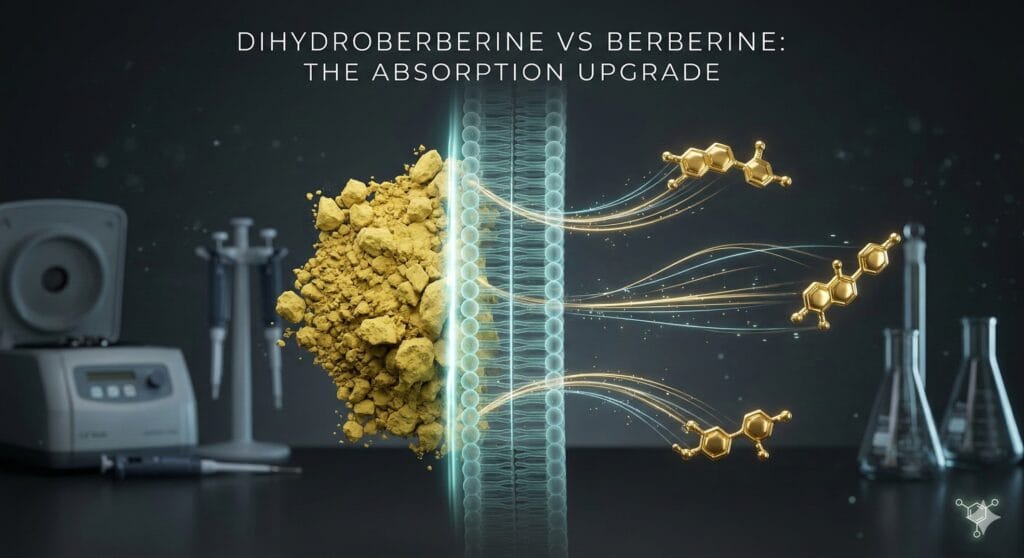
Dihydroberberine vs Berberine: Why Your Berberine Isn’t Working
There’s an uncomfortable irony buried in berberine’s story. Here is a compound with over 30 years of clinical use in Chinese medicine, hundreds of peer-reviewed studies, and a mechanism of action so compelling it gets compared — with some justification — to metformin, one of the most-prescribed metabolic drugs in the world. It activates AMPK, modulates the gut microbiome, improves insulin sensitivity, and shows up in lipid panels. The mechanistic data is genuinely impressive.
And yet: ask around any longevity-focused community, and you’ll find a striking number of people who tried berberine, expected results, and got… not much. Inconsistent blood glucose readings. GI distress bad enough to abandon the protocol. A sense that the molecule is doing something, but nothing reliable.
This is not a placebo failure. It’s not that berberine doesn’t work. The problem in dihydroberberine vs berberine debates sits at a level most supplement discussions never reach: the molecule itself has a fundamental delivery flaw that clinical dosing has never fully solved. Understanding that flaw — and how dihydroberberine addresses it — is the whole story.
What Berberine Does (That Makes It Worth Discussing)
The AMPK Switch
AMPK — adenosine monophosphate-activated protein kinase — functions as a cellular energy sensor. When ATP levels drop and AMP accumulates (i.e., when cells are energetically stressed), AMPK activates and initiates a cascade of metabolic corrections: it stimulates glucose uptake, suppresses fat synthesis, and triggers mitochondrial biogenesis.
Berberine activates AMPK primarily by inhibiting mitochondrial complex I, which slightly reduces ATP production and triggers the AMP/ATP ratio shift that turns AMPK on. It’s an elegant indirect mechanism. The result is a cellular signal that essentially says: conserve fuel, burn what’s available, stop building fat.
Downstream Effects
The downstream consequences of AMPK activation are what made berberine interesting to metabolic researchers in the first place:
- Glucose metabolism: AMPK promotes GLUT4 translocation to the cell surface, improving glucose uptake in muscle tissue independently of insulin. It also inhibits hepatic gluconeogenesis — the liver’s tendency to produce glucose from non-carbohydrate sources.
- Lipogenesis suppression: AMPK phosphorylates and inactivates ACC (acetyl-CoA carboxylase), a key enzyme in fatty acid synthesis. Less ACC activity means less de novo lipogenesis.
- Gut microbiome modulation: Berberine is poorly absorbed in the upper GI tract, which means a substantial fraction reaches the colon intact. There, it reshapes microbial composition in ways associated with improved metabolic signaling — including increased short-chain fatty acid production.
The Metformin Comparison — What Holds Up
The comparison to metformin isn’t purely marketing. Both compounds activate AMPK (though through slightly different mechanisms), both reduce hepatic glucose output, and head-to-head trials in T2D populations have shown comparable HbA1c reductions. The mechanistic overlap is real. Where the comparison breaks down is in clinical depth. Metformin has decades of large-scale safety data, established dosing protocols, and a pharmacokinetic profile that’s been thoroughly characterized. Berberine’s clinical record, while substantial, is largely from smaller studies with variable standardization.
The Longevity Angle
AMPK activation is relevant beyond blood sugar. AMPK suppresses mTOR (mechanistic target of rapamycin), a nutrient-sensing pathway associated with cellular growth and, when chronically overactive, with accelerated aging phenotypes. AMPK → mTOR inhibition → enhanced autophagy is a pathway of genuine interest in longevity research. Berberine sits at an interesting node in that network.
The Absorption Wall: Why Berberine Bioavailability Is the Whole Problem
This is the core of the dihydroberberine vs berberine discussion — and it’s where most supplement coverage gets superficial.
Meet P-Glycoprotein
P-glycoprotein (P-gp) is an efflux transporter expressed in intestinal epithelial cells. Its job, evolutionarily speaking, is to protect the body from xenobiotics — foreign compounds that the gut wall identifies as potential toxins and actively pumps back into the intestinal lumen before they can reach the bloodstream.
Berberine, as a positively charged quaternary ammonium alkaloid, is a high-affinity P-gp substrate. Think of P-gp as a bouncer at the intestinal border who doesn’t just refuse entry to berberine — it actively grabs berberine that’s already made it partway in and throws it back out. The efflux is not passive; it’s an ATP-powered, active rejection.
This mechanism isn’t a quirk of berberine’s structure — it’s a predictable consequence of its molecular charge. And it creates a ceiling on how much berberine can enter systemic circulation regardless of the dose consumed.
First-Pass Metabolism
The absorption problem doesn’t end at the gut wall. Berberine that does make it through the intestinal epithelium faces first-pass metabolism in the liver, where hepatic enzymes convert a significant fraction into inactive metabolites before it reaches systemic circulation. The combined effect of P-gp efflux and hepatic first-pass metabolism suppresses oral bioavailability dramatically.
Multiple pharmacokinetic studies in animal models report oral bioavailability figures in the range of 5% or less for berberine. Human pharmacokinetic data is sparse, but what exists is consistent with extremely limited systemic absorption — peak plasma concentrations after standard doses are low and highly variable between individuals.
The Dose Compensation Trap
Here’s where the supplement industry has historically responded poorly to the berberine bioavailability problem: by simply recommending more of it.
The logic seems intuitive — if 500mg produces low plasma levels, take 1,500mg and the 5% that absorbs gets you to a therapeutic threshold. But this approach fails in two important ways.
First, P-gp efflux is saturable but not defeated by higher doses in a proportional way. The transporter’s capacity means you’re hitting diminishing returns, not a linear dose-response. Second, the fraction of berberine that remains in the GI tract at high doses is substantial — and that fraction causes the GI side effects (nausea, cramping, loose stools) that lead many users to discontinue.
This is the key reframe for anyone who’s had an inconsistent experience with berberine: you weren’t experiencing a placebo response, and berberine wasn’t failing pharmacologically. You were experiencing a delivery problem. The molecule works; the oral delivery format is the limiting factor.
Enter Dihydroberberine: The Delivery Upgrade
Structural Difference
Dihydroberberine (DHB) is the reduced form of berberine. In structural terms, the key difference is at the 7,8 position of the berberine scaffold — DHB carries two additional hydrogen atoms, which partially neutralizes the quaternary nitrogen charge that makes berberine such a good P-gp substrate.
This isn’t a cosmetic modification. The altered charge profile changes how intestinal transporters interact with the molecule.
The Elegant Part: Conversion After Absorption
Here’s the mechanism that makes DHB genuinely interesting rather than just a tweaked version of the parent compound: intestinal cells convert dihydroberberine back into berberine after absorption.
Specifically, DHB is absorbed through the intestinal epithelium (where P-gp efflux is substantially lower due to its modified charge), and once inside, oxidative enzymes in intestinal and hepatic tissue regenerate berberine from DHB. The compound that reaches systemic circulation is, in significant part, the same berberine that would have been present with oral berberine dosing — but the route to get there bypassed the main absorption bottleneck.
This is a prodrug-style mechanism, though DHB isn’t pharmacologically inert itself. It’s a delivery strategy embedded in the molecule’s chemistry, not an external coating or encapsulation technology.
What the Comparative Research Shows
Research comparing DHB and berberine absorption (including work cited in the context of NovaBay Pharmaceuticals’ development of berberine-related compounds) indicates approximately 5-fold greater bioavailability for DHB compared to standard berberine in comparative models. This figure has been repeated in secondary literature, though independent replication in large human trials is still limited.
What this translates to practically:
- Lower effective dose: DHB doses in the 100–200mg range are generally considered equivalent to 500mg standard berberine doses in terms of expected systemic exposure
- Reduced GI burden: Less compound remaining in the GI tract means substantially fewer reports of the cramping and loose stools that commonly accompany high-dose berberine
- More consistent plasma levels: Better absorption tends to produce more predictable blood levels, which correlates with more consistent clinical response
The Honest Caveat
It would misrepresent the evidence to say DHB has matched berberine’s 30-year clinical track record. It hasn’t — it’s a newer delivery form and the human trial database is small relative to berberine’s accumulated research. The mechanism is well-supported and the comparative absorption data is credible, but users should understand they’re working with an evidence base that’s growing, not complete.
Practical Comparison: Standard Berberine vs. Dihydroberberine
|
Feature |
Standard Berberine |
Dihydroberberine |
|---|---|---|
|
Typical dose |
500mg × 2–3/day |
100–200mg × 2/day |
|
Oral bioavailability |
~5% (variable) |
~5× higher in comparative models |
|
GI tolerance |
Moderate–poor at therapeutic doses |
Generally well-tolerated |
|
Cost per effective dose |
Lower unit cost; higher dose required |
Higher unit cost; lower dose required |
|
Clinical evidence depth |
30+ years, extensive literature |
Growing, mechanism-supported |
|
Best for |
Cost-sensitive users; GI tolerant; established protocol |
GI-sensitive users; inconsistent responders; dose efficiency |
Who Should Still Consider Standard Berberine
Standard berberine isn’t obsolete. For users who tolerate it well, have a cost constraint, or prefer a compound with deeper clinical backing, berberine at appropriate doses remains a well-studied metabolic intervention. The absorption limitation matters more for some individuals than others — gut transit time, individual microbiome composition, and P-gp expression levels all vary, which helps explain why some users do well on standard berberine while others don’t.
Who DHB Is Designed For
Dihydroberberine’s value proposition is most obvious for users who: (a) have experienced GI side effects from berberine at doses needed to achieve results, (b) are self-monitoring and have seen inconsistent responses to berberine despite consistent protocol adherence, or (c) want to minimize total compound burden while targeting the same metabolic pathways.
What to Look for When Buying Dihydroberberine
Not all DHB supplements are created equal. Formulation quality matters significantly for a compound where the active dose is relatively small and bioavailability is the primary selling point.
Standardization percentage: Look for products that disclose the DHB content explicitly as a percentage of the extract or as a defined mg amount per capsule. Proprietary blends that obscure the dose are incompatible with the precision that makes DHB’s lower dosing meaningful.
Third-party testing: Given DHB’s higher cost relative to berberine HCl, the category is vulnerable to adulteration or mislabeling. Certificate of Analysis (CoA) from an independent lab — ideally verifying both potency and purity — is the baseline for any serious purchase.
Excipient quality: Some lower-quality formulations use excipients that may interfere with absorption or stability. Minimal, clean excipient lists are preferable.
Manufacturing transparency: cGMP manufacturing certification and batch-level traceability are markers of serious production standards.
For the Science-First Formulation: Renue by Science
Renue by Science (affiliate link) produces a DHB formulation with disclosed standardization and third-party testing infrastructure. Their approach to the berberine bioavailability problem is consistent with the mechanistic rationale discussed here.
→ Verify DHB Formulation & Pricing (affiliate link)
Bridging to NAD+ Biology: Why This Stack Makes Sense
The AMPK pathway that makes berberine (and DHB) interesting shares downstream targets with the NAD⁺/sirtuin axis that NMN supplementation supports. Specifically, both AMPK activation and sirtuin activity converge on PGC-1α — the master regulator of mitochondrial biogenesis — and both pathways contribute to the same cluster of metabolic outcomes: improved insulin sensitivity, enhanced fatty acid oxidation, and mitochondrial function.
AMPK also activates SIRT1 directly through NAD⁺-independent mechanisms, and elevated NAD⁺ levels (the target of NMN supplementation) amplify sirtuin activity independently. These are complementary, not redundant pathways. For a deeper look at how NMN bioavailability affects the efficacy of NAD⁺ precursor supplementation, see our NMN Bioavailability deep-dive on ThriveTrilogy — the absorption mechanics parallel the berberine story in interesting ways.
NMNBio (affiliate link) offers pharmaceutical-grade NMN with documented batch testing — the NAD⁺ precursor that pairs with AMPK activation for the mitochondrial biogenesis side of the longevity stack.
→ Verify NAD+ Clinical Batch (affiliate link)
The Chemist’s Protocol: How to Stack This
The timing logic here follows DHB’s optimal pharmacodynamic window (pre-meal, to blunt postprandial glucose spikes) and NMN’s sirtuin activation window (morning, fasted, to align with circadian NAD⁺ cycling). DHB and NMN do not share known adverse interactions — they act on complementary pathways (AMPK and NAD⁺/sirtuin, respectively) — so concurrent use is supported by the available evidence. The only practical reason to separate them is timing optimization, not conflict avoidance.
|
Time |
Compound |
Dose |
Why |
|---|---|---|---|
|
Morning, fasted |
NMN |
500mg |
NAD⁺ precursor loading aligns with circadian peaks in sirtuin activity; fasted state improves uptake |
|
15–30 min pre-lunch |
DHB |
100–200mg |
Pre-meal dosing blunts postprandial glucose spike from the day’s largest meal window |
|
15–30 min pre-dinner |
DHB |
100–200mg |
Second largest glucose load of the day; pre-meal timing preserves the AMPK activation window |
Why not DHB and NMN simultaneously? There’s no known mechanistic conflict. The separation is about optimization: NMN benefits from the fasted state for absorption and circadian alignment; DHB’s value is pre-meal. Combining them at the same time sacrifices one or both timing advantages for no pharmacological reason.
This is educational context, not medical advice. Consult a healthcare provider before starting any new supplement protocol.
The Bottom Line
Dihydroberberine isn’t a marketing invention. It’s a genuine delivery improvement on a compound with legitimate metabolic science behind it — one that solves a well-characterized pharmacokinetic problem (P-gp efflux, poor oral bioavailability) through a structurally elegant mechanism (prodrug-like absorption with post-uptake conversion).
Standard berberine deserves its reputation. Thirty years of clinical data isn’t noise, and for users who tolerate it well, it remains a credible metabolic intervention. The delivery problem doesn’t erase that record — it explains why that record is more consistent for some people than others.
For the subset of users who’ve taken berberine carefully, consistently, at appropriate doses, and gotten unreliable results — DHB offers a plausible, mechanistically grounded explanation for why, and a delivery upgrade worth considering. Lower dose, better GI tolerance, and more predictable absorption aren’t marketing claims when they follow directly from the chemistry. That’s just the molecule working as designed.
The honest verdict: if standard berberine works for you, there may be no compelling reason to switch. If it doesn’t — or hasn’t — the delivery problem described here is the most likely culprit, and dihydroberberine addresses it at the right level.
For the Metabolic & Longevity Stack
Renue by Science — DHB (Dihydroberberine)
Third-party tested DHB with disclosed standardization. Consistent with the berberine bioavailability science discussed above.
→ Verify DHB Formulation & Pricing (affiliate link)
NMNBio — Pharmaceutical-Grade NMN
Batch-verified NAD⁺ precursor for the complementary sirtuin activation pathway. Pairs with AMPK-targeted protocols via PGC-1α convergence.
→ Verify NAD+ Clinical Batch (affiliate link)
⚠️ Reminder: Both links above are affiliate links. ThriveTrilogy may earn a commission on purchases at no additional cost to you. Product mentions reflect formulation consistency with the science discussed, not paid promotion.
Frequently Asked Questions
Is dihydroberberine better than berberine?
It depends on what “better” means for the individual user. Dihydroberberine addresses a specific and well-documented problem with standard berberine — poor oral bioavailability due to P-glycoprotein efflux — through a structurally modified form that absorbs more efficiently and converts back to berberine after uptake. Comparative absorption data suggests approximately 5-fold greater bioavailability in relevant models, which translates to lower effective doses and significantly reduced GI side effects. For users who have experienced inconsistent results or GI intolerance with standard berberine, DHB represents a meaningful delivery upgrade. For users who tolerate berberine well and see consistent results, the clinical case for switching is less compelling — standard berberine has 30+ years of research behind it that DHB’s evidence base has not yet matched.
Why does berberine cause stomach problems?
Berberine’s GI side effects are a direct consequence of its poor absorption. Because P-glycoprotein actively ejects berberine from intestinal epithelial cells, a large fraction of any oral dose remains in the GI lumen rather than entering the bloodstream. At high doses (the 1,000–1,500mg/day ranges often recommended to compensate for low bioavailability), this unabsorbed berberine exerts antimicrobial effects on intestinal flora, alters gut motility, and can directly irritate the intestinal lining. The result is the cramping, nausea, and loose stools commonly reported. Dihydroberberine, by absorbing more completely in the small intestine, leaves substantially less compound in the gut — which is the primary reason for its significantly better GI tolerance profile.
How much dihydroberberine should I take?
Based on the available research and the ~5-fold bioavailability advantage, DHB doses of 100–200mg are generally considered pharmacokinetically comparable to 500mg standard berberine. Most protocols use DHB twice daily (around 200–400mg total), timed 15–30 minutes before the two largest meals of the day to target postprandial glucose management. However, appropriate dosing is individual, depends on body weight, metabolic status, and concurrent medications, and should be established in consultation with a qualified healthcare provider rather than from generic supplementation guidance.
Can I take berberine and NMN together?
There is no known pharmacological conflict between berberine (or DHB) and NMN. They act on complementary rather than overlapping pathways — DHB/berberine activates AMPK, while NMN supports the NAD⁺/sirtuin axis. Both pathways converge on PGC-1α and mitochondrial biogenesis outcomes, making the combination additive rather than redundant. The practical reason to separate their timing is optimization rather than safety: NMN benefits from morning fasted dosing for absorption and circadian alignment, while DHB’s value is concentrated in pre-meal windows. Taking them simultaneously at the wrong time would sacrifice the timing advantage for one compound without any offsetting benefit. As with any supplement combination, especially for individuals on medications or with existing health conditions, confirming this protocol with a healthcare provider is advisable.
This article is for educational and informational purposes only. It does not constitute medical advice, diagnosis, or treatment recommendations. Always consult a qualified healthcare professional before making changes to your supplement regimen.Partager

M.Sc. in Organic Chemistry. I analyze health supplements and wellness trends through a scientific lens, breaking down ingredients and chemical profiles to separate marketing hype from biological reality.